|

State Office Building - 2/8 Kimball
333 Willoughby Ave.
Juneau, Alaska
Organ installation timeframe: 1976 - present
Back to the Northwest Public Theatre Organ Installations page
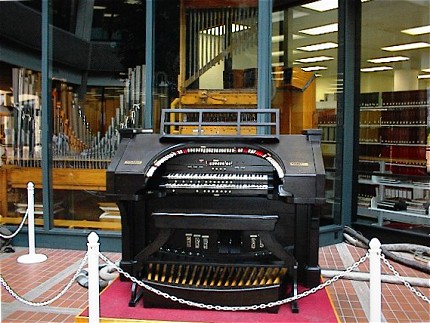
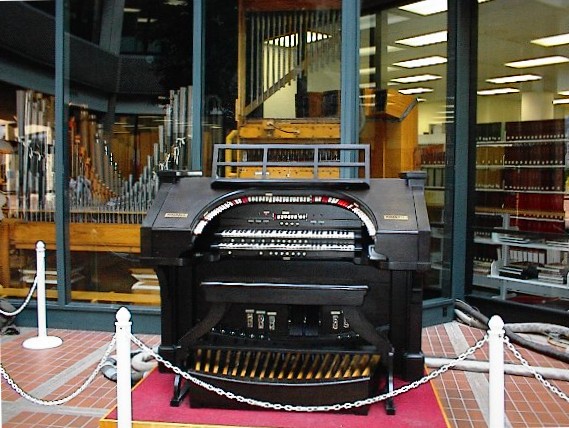
Kimball console. Photo courtesy Terry Robson, 2002
The State Office Building Kimball was originally installed 1928 in Juneau's Coliseum Theatre. It was later moved to the 20th Century Theatre in 1939-1940.
The instrument was moved to its present location in 1976-77 by Balcom & Vaughan. Don Myers, Bill Bunch and the late Franklin Butte did the installation. An opening program was given in May 1977.
An article in THEATRE ORGAN Winter 1978 (Vol20 No1, pp12-14) provides more details of the instrument and its history.
Over the years, J. Allan MacKinnon and guest artists have presented Friday noontime concerts featuring classical and popular music. Organists and visiting musicians from the cruise lines also provide music on a short notice basis.
More information about the State Office Building Kimball, including the 1977 Dedication Program can be found in this Alaska State Library Historical Collections Guide document.

Pipework. Photo courtesy Terry Robson, 2002
 |
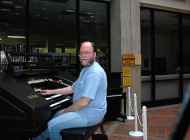
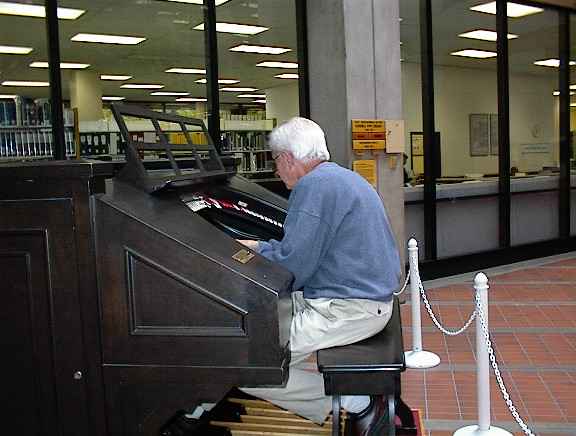
Bob Shafter

Jerry van der Pol |
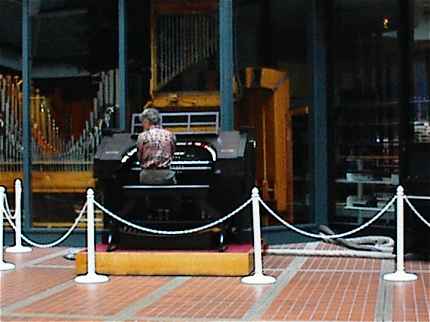
Mark Renwick
Photos by Terry Robson taken during the Columbia River Theatre Organ Society "Organ Cruise," August 2002.
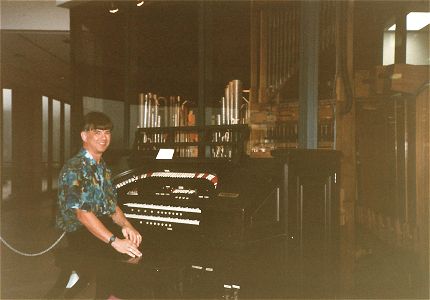
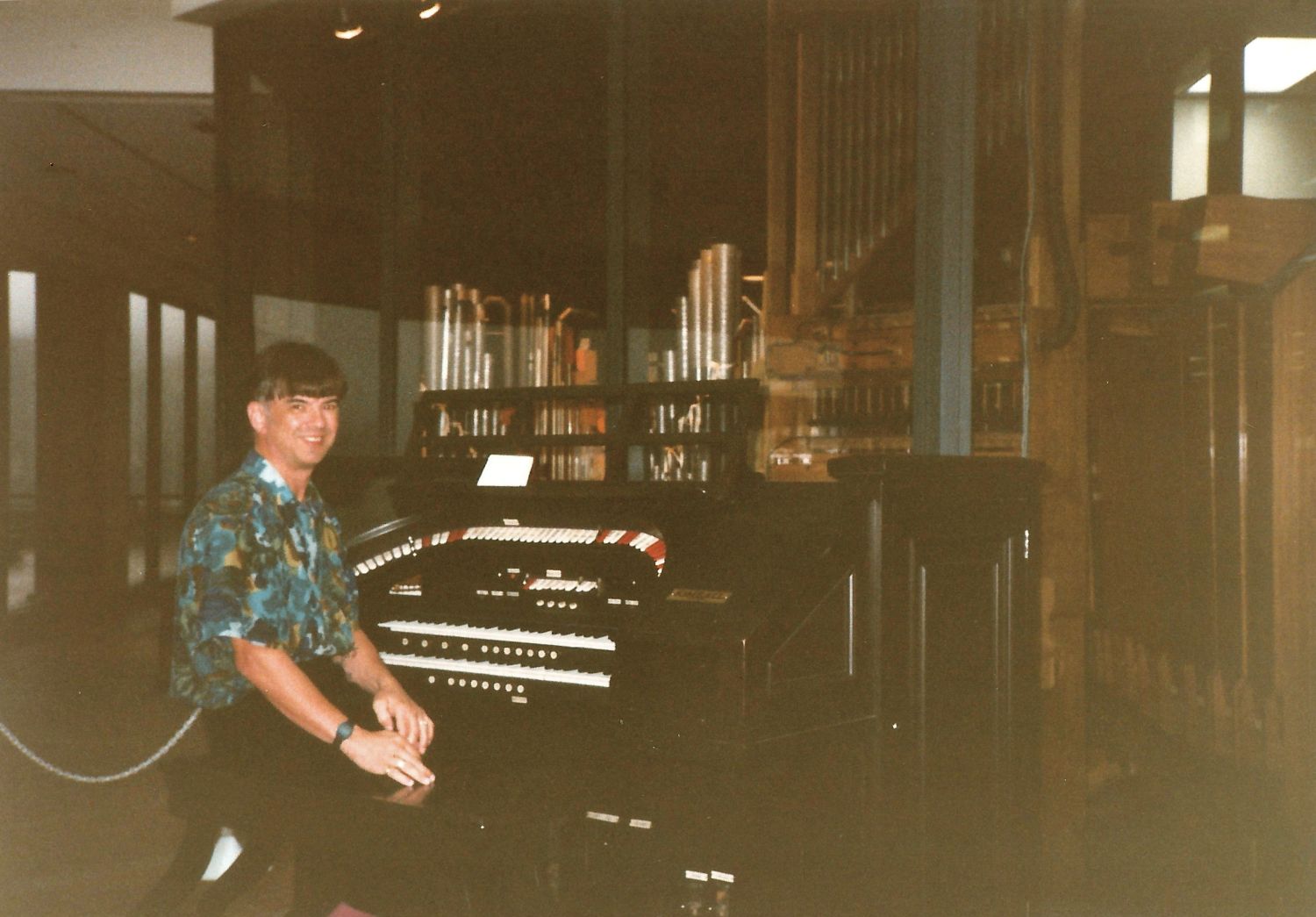
Jeff Fox, 1993
Friday concerts bring historic organ to life
By I-CHUN CHE, JUNEAU EMPIRE - April 18, 2005
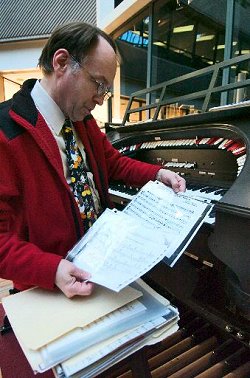
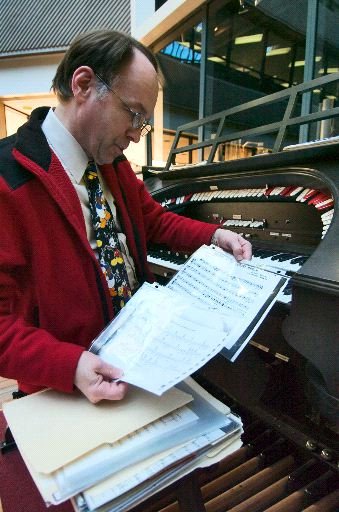
Best seat: J. Allan MacKinnon selects music during his performance on the Kimball pipe organ Friday in the State Office Building. Photo by Michael Penn, Juneau Empire |
Every Friday at noon, J. Allan MacKinnon turns a 77-year-old Kimball pipe organ into a one-man orchestra, the lobby of the State Office Building into a concert hall.
With his touch, the organ comes alive with its 548 pipes, bird whistles, sleigh bells, drums, xylophone and glockenspiel. Tones, sometimes glorious, sometimes melancholy, resonate throughout the sun-lit building. When he plays Johann Sebastian Bach's "Toccata in D Minor," the landscaped area in front of the organ is the best seat for hearing the roaring, solemn notes hitting the building's glass ceilings and bouncing back.
"It's all about interpreting music, about arranging music for people to enjoy," said MacKinnon said. "This is the last intact theater organ in the state." |
MacKinnon is the only person who regularly plays the organ. For the rest of the week, the giant organ sits mute behind glass panels in the lobby of the State Office Building.
The organ had its golden days.
In 1928, W.D. Gross, pioneer Alaska theater owner, had the organ built for his Coliseum Theater on South Franklin Street. The instrument complemented silent movies and was used until 1926, when talking motion pictures replaced the silents.
When Gross built the 20th Century Apartment-Theater on Front Street in 1939, the organ was moved to the theater with its console at the center of the stage.
"The console of the organ had its main cables running along the cement floor under the stage, so during the 13 years that organ sat in this position, the cables eventually became water-soaked and began to rot," MacKinnon, 60, said.
Then came Franklin Butte, a radio engineer stationed with the Army Signal Corps in Juneau. He rewired the main cables into the console and revived the organ. During 1954 and 1955, the organ was played daily before each evening show.
With the advent of Cinemascope pictures in 1953, the 20th Century Theater moved the organ console and cut the organ chambers to make room for a big screen.
"This was bad for the organ, for most of the sound from the pipes escaped through the holes in the ceiling resulting from this alternation instead of being projected to the auditorium," MacKinnon said.
The organ's traps were damaged during the reconstruction.
Then MacKinnon came along.
MacKinnon, who worked as a doorman at the theater in 1961, took upon the task of restoring the organ. He had learned how to play piano at age 7 and organ at 14 from Carol Beery Davis. And he had helped install another pipe organ in Juneau.
With the help of a theater maintenance man, MacKinnon rewired 73 trumpets into the console, built a direct electric relay under the pedals and moved the traps back into the organ.
The mighty Kimball organ was resurrected once again and used every Thanksgiving and Good Friday when the whole community gathered in the theater.
According to a 1977 Southeast Alaska Empire, the organ was played during statehood ceremonies by Butte in 1959 and during a visit to Juneau by John F. Kennedy. The organ was also featured on local radio shows with Milton Furness Jr. as announcer and Butte as organist.
In 1970, Miles and Letha Remley purchased the organ. They donated it to the Alaska State Museum in 1975. But the state museum wanted to dump the organ for more office space.
"The museum didn't know what to do with the organ," MacKinnon said. "This is not a Totem pole or an eagle tree. This is not something you install and let it sit there. It needs to be used."
This time, the whole community of Juneau came to rescue.
A citizen ad hoc committee raised $30,000 to restore the organ. Architect Frank Maier designed a glass showcase to store the organ in the lobby. Senator Bill Ray secured funding in the state museum's budget to build this "security enclosure." The organ was rewired by the company owned by C.M. Balcom, who installed the organ in Gross' Coliseum Theater in 1928.
Since then, it has become a tradition to have a Friday lunch concert.
After Butte and Davis died, and MacKinnon, who works for the state as an employment security analyst, carried the torch. In memory of Butte, MacKinnon plays Butte's signature song, "The Liberty Bell," every time.
His performance is full of action.
When he plays, his feet dance busily on the whale-rib-like pedals, his Mickey Mouse tie swinging along. The shutters at the top of the organ fold and open as he controls the volume with a pedal. The glass panels that enclose the organ vibrate with music.
MacKinnon selects his music according to the occasion and the audience.
To celebrate last week's Folk Festival, MacKinnon played some of Bob Dylan's songs, such as "Mr. Tambourine Man," "The Times They Are A-Changin'" and "Blowin' in the Wind." He also played a Scottish medley of "Johnnie Scobbie," "The Road to the Isles" and "Scotland the Brave."
MacKinnon plays theme songs from Walt Disney movies such as "Pocahontas" for elementary school students who take a field trip at the Juneau-Douglas City Museum and come to the State Office Building afterward for a lunch break.
MacKinnon has some loyal fans.
Carol Gray, a bookkeeper who works near State Office Building, goes to MacKinnon's concert almost every Friday.
"I sit here, looking at this fantastic view and listening to this glorious music," Gray said. "What a great way to take a lunch break."
MacKinnon now in 29th year of Kimball concerts
By Vanessa Orr, CAPITAL CITY WEEKLY - January 18, 2006

J. Allan MacKinnon plays the pipe organ Friday, Jan. 13 at the State Office Building
Back in the late 1920s, a night on the town might mean going to the Coliseum Theatre on Franklin Street and watching a moving picture. Though talking pictures didn't yet exist, the audience was still surrounded by sound as the music of a massive Kimball pipe organ set the stage for the drama unfolding on screen.
That same organ is still delighting audiences today as music pours from its 548 pipes through the grand lobby of the State Office Building. Almost every Friday since 1977, J. Allan MacKinnon has played a lunchtime concert for anyone who wants to attend, from school groups to cruise ship passengers, to organ club aficionados who travel all the way to Juneau just to hear its dulcet tones.
"I'm kind of carrying on a tradition," said MacKinnon of his almost 30-year volunteer career playing the organ. "I began playing here at the May 1977 dedication of the instrument, and now I'm the only person who still regularly plays it, though we do occasionally have traveling artists come through and perform."
MacKinnon has a long history with the instrument, which he first became acquainted with in 1961 when he began working as a doorman at the 20th Century Theatre.
"I messed around with it then," he said, "when I wasn't working for $1 an hour tearing tickets."
Built in 1928 for W.D. Gross, the organ had originally been designed to accompany silent pictures in the Coliseum Theater. It was moved to Gross's 20th Century Theatre in 1939, where it remained for 38 years.
"It was fortunate that the organ was moved when it was, because the Coliseum Theatre was completely lost during a whale of a fire in the early 1940s," MacKinnon said.
Unfortunately, the organ fell into disuse until the early 1950s, when Franklin Butte, a radio engineer stationed with the Army Signal Corps in Juneau, repaired the instrument's wiring so that it could be used by community groups and also to herald the theater's evening show.
"In the 1950s and 60s, we played the organ before movies in the evenings and on Saturday afternoons," MacKinnon said. "But due to changes in management, it was decided to sell the organ in 1970, and Myles and Letha Remley bought it and later donated it to the Alaska State Museum."
When the museum decided that they needed more space and the organ needed to find a new home, the Juneau Arts and Humanities Council took on the project.
"They started a local movement to restore the instrument and to get it installed somewhere where it could be used," MacKinnon said. "I don't remember who had the idea to install it in the grand lobby of the SOB, but it was the perfect space."
In 1977, the dedication ceremony took place and the public, as well as numerous dignitaries including Governor Jay Hammond, packed the space.
"Carol Berry Davis played some silent movie music, and Franklin Butte played most of the rest of the program," MacKinnon said. "I even played a tune or two."
These days, MacKinnon attracts a wide fan base to his Friday afternoon concerts, which can feature anything from Broadway show tunes to classical concertos to a Bob Dylan tribute.
"I don't play any 50 Cent or rap," he laughed. "There are certain types of music that work fine on a theater organ, and other types that don't."
When the Juneau-Douglas Class of 1944 was in town for a reunion, MacKinnon put together a 15-minute medley of tunes popular in those times.
"That seemed to mean a lot to those folks," he said. He also tailors his programs to school groups, including Disney songs and sing-alongs for the younger crowd.
When he's not playing the Kimball organ, MacKinnon serves as the director of music at Northern Lights Church, and also occasionally plays the carillon bells at the Sealaska Building. Born and raised in Juneau, MacKinnon started playing piano at age seven and the organ at age 14. After receiving his arts degree at Sheldon Jackson College, he earned a bachelor of music degree from Westminster Choir College of Ryder University.
"I think it's nice to interest the younger folks in playing, especially since across the country, there's been a downturn in the number of organists, and in people entering the music field in general," MacKinnon said. "There are also fewer and fewer theater organs available to play in public buildings-to the best of my knowledge, this is the only state office building that has an operational pipe organ that was built for a theater in place."
MacKinnon is happy to play special requests, which often include the National Anthem and the Alaska Flag Song, as well as tributes to those in the service.
"When I was asked to put together a tribute to Bob Dylan, I said, 'okay, but I ain't singing,'" he laughed.
Fortunately for the people of Juneau and the guests who come to our city, for the past 29 years, MacKinnon has continued to play.
"Sometimes you volunteer to do something, and after awhile, it becomes like a job, even though you're not getting paid," he said. "But it's still fun. If it stopped being fun, I wouldn't do it."
80 Years of Music
By Katie Spielberger, CAPITAL CITY WEEKLY - July 9, 2008
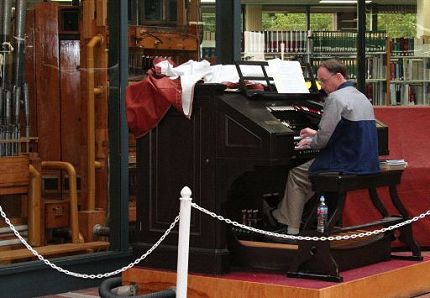
JUNEAU - Step into the State Office Building during the noon hour on a Friday and you'll hear strains of music from pipes older than the state itself. This year marks the 80th birthday of the Kimball pipe organ, the last intact theatre organ in Alaska.
The organ was first installed at the Coliseum theatre, W.D. Gross' original movie theater in Juneau, in 1928.
When W.D. Gross placed an order for a theatre organ in 1927, he also placed an order for an organist. He was concerned that the organist would stick to the silent movie cues and not improvise. He also was concerned about the organist staying sober.
"For God's sake don't send me a drunk," W.D. Gross wrote to a Kimball representative in Seattle.
The Kimball's first organist, Carol Beery Davis, must have far exceeded W.D. Gross's expectations. She played at the Coliseum Theatre for six years and trained a new generation of organists, including J. Allan MacKinnon.
MacKinnon has now been playing the Kimball organ for nearly fifty years. In the early 60's he worked as a "doorman" for Gross' 20th Century Theatre downtown. He'd been taking piano lessons since age seven and started studying the organ with Carol Beery Davis.
"I got interested in the (Kimball) organ," he said. "(I'd) play before or in between movies ... just for the heck of it."
In 1970, Miles and Letha Remley purchased the organ and in 1975 they donated it to the Sate of Alaska as a museum piece to be installed in a public place. A "Save the Organ" campaign raised the $30,000 needed to restore and install the Kimball in the State Office Building.
In the late 70's and the 80's, there were quite a few organists who would regularly play the Kimball.
"There were almost enough to play five days a week,"MacKinnon said.
Now, 80 years after Carol Beery Davis first arrived to be the Kimball's sole organist, one of her students has become as closely associated with the organ as she once was.
MacKinnon is the Kimball's last regular organist.
"Everyone (who used to play regularly) has either died, retired or left town," MacKinnon said. MacKinnon can name a number of talented local organists, but most of them do not regularly play the Kimball. Aside from MacKinnon, Alice Branton is the organist Kimball aficionados might see most often these days.
During his own Friday noon concerts, MacKinnon plays pieces ranging from Bach to show tunes and movie themes. A few years ago he started playing a medley of service songs from the various branches of the U.S. military. Audience members stand when he breaks into the national anthem.
"I think people like to have a variety," he said. As he plays, MacKinnon glances away from the sheet music to see who walks by. He usually sees a number of regulars, and the Friday concerts have been listed in enough visitor publications over the years to attract a steady stream of out-of-towners.
MacKinnon noted that the audience at a recent concert included visitors from Australia, California, Michigan and Oregon, as well as a couple from British Columbia sailing Alaskan waters for two-months in their 33-ft sailboat.
There are usually children at MacKinnon's concerts. He often plays Disney pieces like the "Mickey Mouse Club" theme. He enjoys talking to children about music.
"When people bring their young people up ... they tell me what instrument they play. 'I play the violin.' 'I play the piano,'" MacKinnon said.
The children press their faces up to the glass case the houses the organ's 538 pipes. They watch MacKinnon's hands and feet maneuver the organ's keyboards, pedals and stops.
Perhaps one of them might become the organist that helps keep the Friday concerts going for another 80 years.
The Kimball organ marks 30
Instrument is last working theater organ in the state
By Korry Keeker JUNEAU EMPIRE - April 27, 2009

When the State Office Building was completed in the early 1970s, the eighth-floor atrium was a giant empty space. Sure, the view was nice, but by most accounts, the room felt like a cave.
In 1977, the Juneau Arts & Humanities Council helped move a then-49-year-old Kimball Theatre Organ into the void. It's stayed there ever since, filling the space at noontime Fridays with music from its 548 pipes.
At noon today, a modest crowd of dignitaries will celebrate the 30th anniversary of the Kimball's dedication in the office building. The public is welcome to attend the free ceremony.
The proceedings will be broadcast live on KRNN/102.7 FM and also will be available online at www.ktoo.org
"This is about the historical significance of the fact that we have the last intact theater organ in the state of Alaska that was built for an Alaskan theater," said J. Allan MacKinnon, the organ's principal player since 1977.
"There's maybe some parts of organs in somebody's garage up in Anchorage and Fairbanks, but they're not together and they're not being played," he said. "This is a historical piece of memorabilia, and to think they were doing this stuff in the 1920s and 1930s is incredible."
Theater owner W.D. Gross had the organ built in 1928 for his Coliseum Theater on South Franklin Street. The Coliseum was a hot spot back then, and Juneau residents flocked to hear the Kimball organist play along to silent movies. In 1939, Gross moved the organ to the then-brand-new 20th Century Theater on Front Street.

It would remain there for 38 years. But the Kimball was rarely used for much of the 1940s and its cables rotted from water damage.
Radio engineer Franklin Butte rewired the cables in the early 1950s, and the Kimball was used throughout the 1950s and 1960s.
The theater decided to sell the organ in 1970. It was bought by Miles and Letha Remley, who eventually donated it to the Alaska State Museum in 1975.
The museum struggled to find a good space for the organ, until the Juneau Arts & Humanities Council and a committee of organ fans became involved. The committee raised $30,000, the organ was restored and architect Frank Maier constructed a glass space for the instrument in the eighth-floor atrium of the State Office Building.
Gov. Jay Hammond was one of many dignitaries at the dedication ceremony in 1977. Butte, MacKinnon and wellknown Juneau musician Carol Beery Davis played tunes.
"The folks that donated the organ to the state museum back in the '70s were very specific about it not leaving Juneau," MacKinnon said. "They wanted it restored and put into a public place, where people could enjoy it and so forth."
Connie Boochever was one of the leaders of the Save The Organ committee three decades ago. Her daughter, Ann, will be at today's ceremony.
Spencer Miller, Ann's son, will lead the crowd in a spirited rendition of the "Alaska Flag Song."
Judge Tom Stewart will be present. His late wife, Jane, played an active role on the Save the Organ committee.
Annette Kreitzer, commissioner of the Department of Administration, will be on hand, and Ben Brown will emcee.
MacKinnon, known for his regular noon Friday concerts on the organ, will perform. Linda (Kassner) Loos, a 1956 Juneau High School graduate, also will play a few selections on the organ. Kassner Loos was a student of Carol Beery Davis.
Scott and Ellen Carrlee, both of the Alaska State Museum, will address the historical significance of the organ.
"Scott reminds me that this is one of the only items in the Alaska State Museum collection that people can interact with in this kind of fashion," MacKinnon said. "It's interesting from the historical perspective of where it came from, where it's been and how it was restored and put into this public place for people to enjoy."

|
Alaska Kimball going into State Building
Excerpt from The Console Magazine, September 1976 (v14, No. 9 pp7):
One of the two Kimball theatre organs that found their way to Alaska during the silent film era is being refurbished and will be erected in a State building in Juneau. Don Meyers, Balcom & Vaughan Pipe Organs, Inc., technician, will make the installation, it has been learned.
|
|